
Lexington County Criminal Court Records
Criminal court records in Lexington County are maintained through the trial court system once a case opens. Circuit Court includes General Sessions for felony and higher-level criminal prosecutions. Magistrate Court and Municipal Court handle lower-level criminal, traffic, ordinance, bail, preliminary-hearing, and warrant matters. The Clerk of Court maintains General Sessions records, while the Solicitor prosecutes criminal cases for Lexington County as part of the Eleventh Judicial Circuit.
The Eleventh Circuit Solicitor's homepage is an official source for the local prosecution office: Eleventh Judicial Circuit Solicitor.
The Solicitor's role is central to criminal case progress, first appearances, diversion review, pleas, and prosecution decisions.
Search Lexington County Criminal Cases
The main public search path is the Lexington County Public Index reached through the state case-records search page. Criminal users can search by defendant name, case number, indictment number, court agency, date range, case type, or action type. Public Index is useful for docket entries and case status, but certified copies and older files may require the Clerk of Court. Arrest and booking data are separate from the full court case file.
- Open the South Carolina case records search page and choose Lexington County.
- Search by defendant name, business name if relevant, indictment number, or case number.
- Narrow by court agency, case type, action type, and date range when results are broad.
- Open the case detail screen to read parties, actions, documents, disposition, and financial tabs.
- Contact the Clerk of Court for certified copies, older files, or unclear case matches.
The Solicitor publishes criminal-case and public-record links for the Eleventh Circuit: Solicitor public record links.
That source points users back to official county and court systems rather than third-party criminal-record aggregators.
Lexington County Criminal Case Flow
A criminal court record grows as the case moves from accusation to outcome. A booking charge may appear first in a sheriff or jail system, but the court file becomes the main record when formal charges, hearings, pleas, or dispositions enter the court. The Solicitor's General Sessions page notes that during first appearance, an assistant solicitor meets with the defendant and defense counsel and outlines case progress and resolution options.
Case flow: Charges Filed › Arraignment › Pretrial and Motions › Plea or Trial › Disposition › Sentencing
| Stage | What the Record May Show |
|---|---|
| Charges Filed | Complaint, indictment, charge text, offense level, or case opening event. |
| Arraignment | Initial court appearance where charges and plea activity may be addressed. |
| Pretrial and Motions | Bond, discovery, continuances, suppression motions, notices, and hearing settings. |
| Plea or Trial | Guilty plea, not guilty plea, bench or jury trial activity, verdict, or agreement. |
| Disposition | Dismissed, guilty, not guilty, nolle prosequi, diversion outcome, or other case result. |
| Sentencing | Fine, custody, probation, restitution, or other court-ordered consequence. |
The General Sessions source for the Solicitor is here: Eleventh Circuit General Sessions.
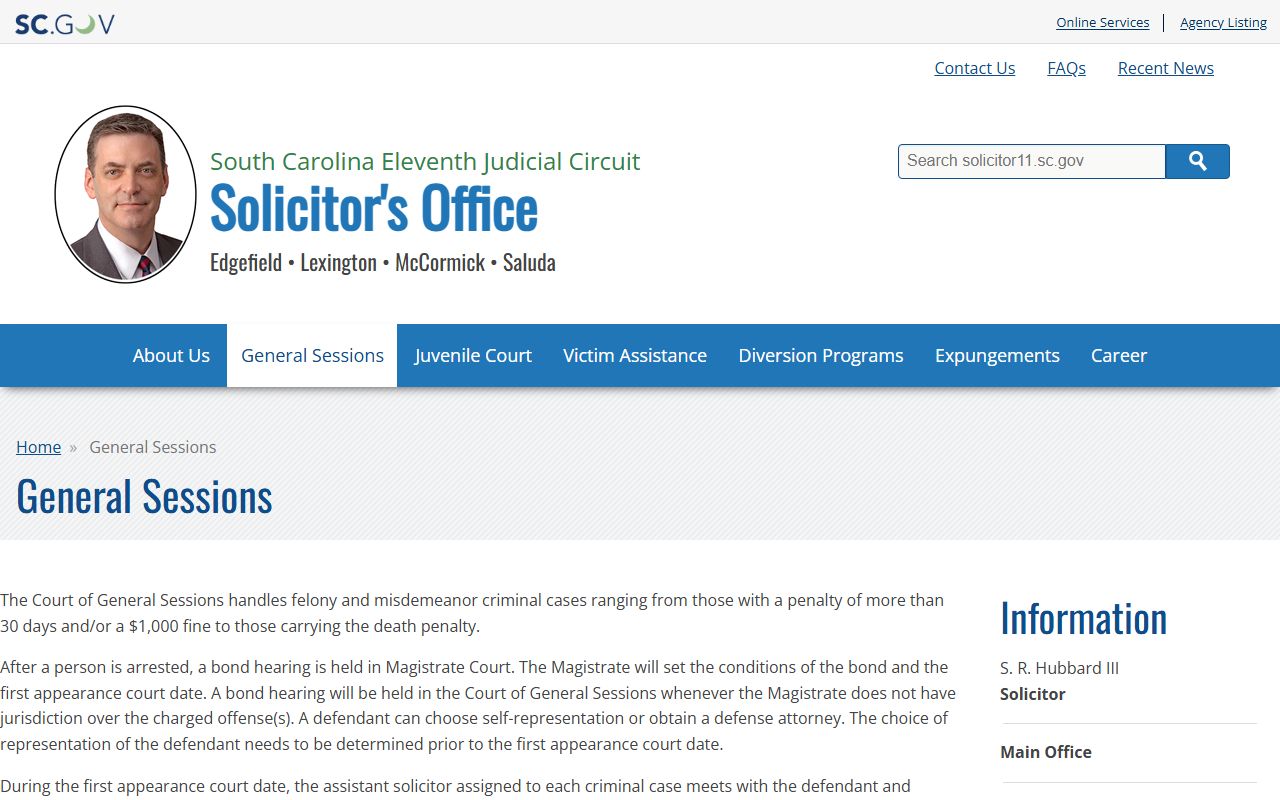
General Sessions is the key criminal case path for serious Lexington County criminal prosecutions.
What Criminal Court Records Show
A Lexington County criminal court record can show the defendant name, case number, court agency, charges, indictment number, docket actions, attorney information, bond events, plea, disposition, sentence, financial obligations, and document icons when available. Public Index can also show tabs for associated cases and financials. The record should be read as a case timeline, not as proof that every early charge ended in a conviction.
| Field | What It Shows |
|---|---|
| Case Number | The court's unique identifier for the criminal case file. |
| Defendant | The person charged, plus limited public demographic fields when display is allowed. |
| Charges | The offense accusations filed with the court, which may later change. |
| Indictment Number | A formal charge reference when a General Sessions indictment applies. |
| Plea | The defendant's formal answer, such as guilty or not guilty. |
| Disposition | The outcome of a charge or case, such as guilty, dismissed, not guilty, or nolle prosequi. |
| Sentence | Custody, probation, fine, restitution, or other court-ordered result. |
| Financials | Fines, costs, restitution, bond, or other money entries when applicable. |
Charges and Convictions
Charges and convictions are not the same. A charge is an accusation filed after law enforcement, a magistrate, and the prosecutor's office move a matter toward court. A conviction is a final result after a guilty plea, verdict, or other qualifying adjudication. A single arrest can lead to multiple charges, and charges can be amended, reduced, dismissed, or resolved through diversion.
| Charge | Conviction | |
|---|---|---|
| Meaning | Formal accusation in the court process. | Finding or plea of guilt. |
| Timing | Appears before the final outcome. | Appears after plea, verdict, or qualifying judgment. |
| Can change | May be amended, reduced, dismissed, or dropped. | Can be appealed, corrected, or later affected by expungement if eligible. |
| Best source | Public Index, Solicitor path, charging document. | Disposition and sentencing entries in the case file. |
The separate Lexington County arrest records and charges page focuses on booking charges and formal charge status before the full case outcome.
Diversion and Treatment Outcomes
Lexington County criminal court records may show diversion-related outcomes when a case is eligible and the Solicitor approves a program path. Pre-Trial Intervention can result in a noncriminal disposition after successful completion, and the participant may apply for an order destroying official arrest records related to the arrest. If a participant violates program terms, the charge may return to the originating court.
The Solicitor's PTI program source is here: Pre-Trial Intervention.
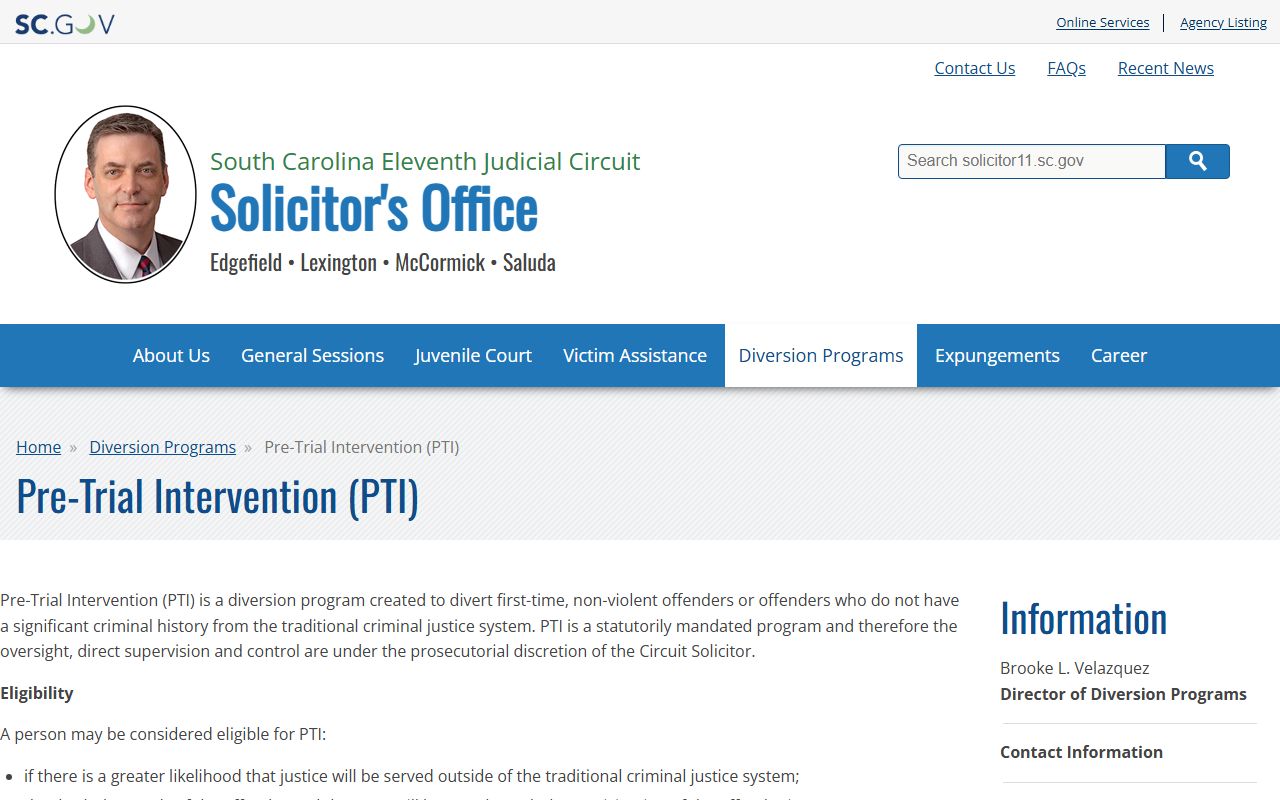
PTI can affect how a criminal court record resolves, but expungement after completion is a separate responsibility.
Adult Drug Treatment Court is another Lexington County diversion program operated by the Solicitor. It is a problem-solving and treatment path rather than a public-record search portal, but participation may affect the record's case activity, supervision, compliance entries, and later eligibility questions.
The Drug Treatment Court source is here: Lexington County Adult Drug Treatment Court.
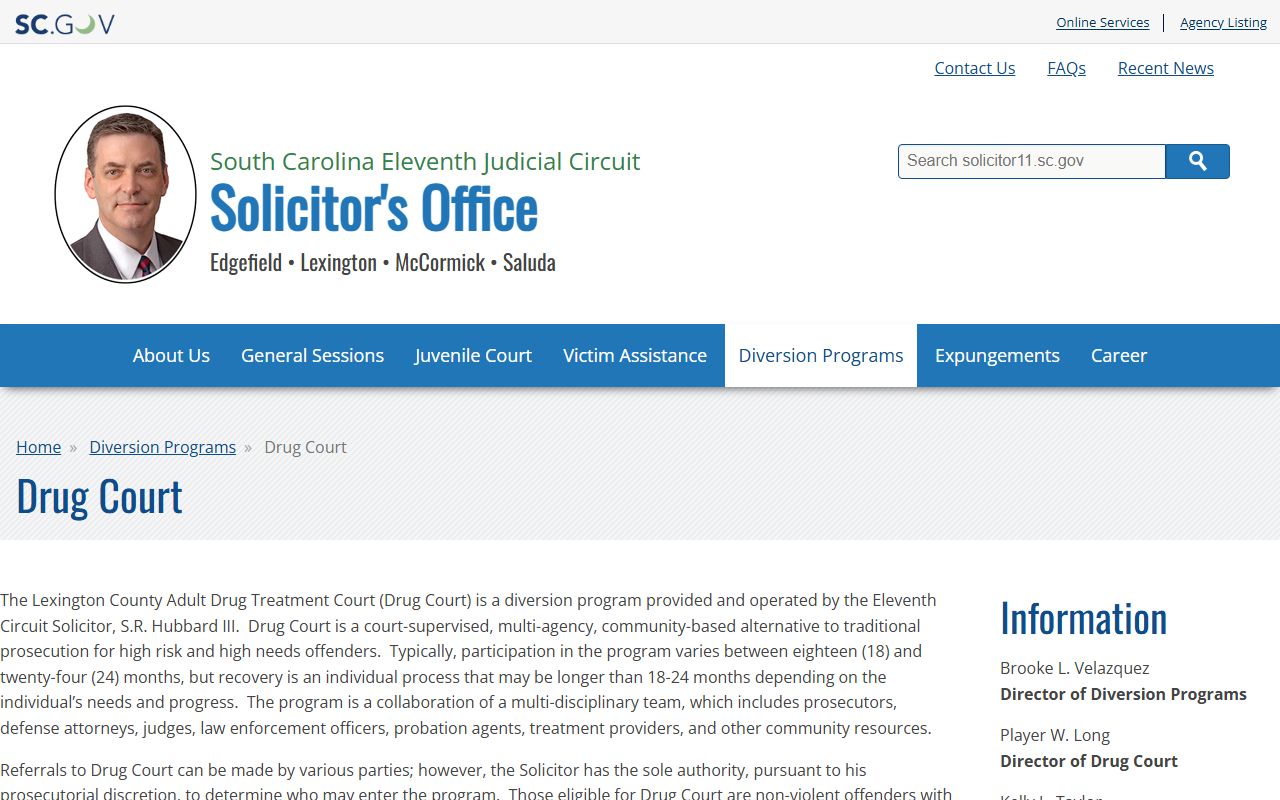
Treatment court information is useful context when a criminal docket shows program participation instead of a simple trial-to-sentence path.
Sealed and Expunged Records
South Carolina law limits public access to some criminal records. Juvenile records are confidential except under statutory or court-order conditions. Some dismissed, not-guilty, or discharged criminal records may qualify for expungement or sealing. The Solicitor handles expungement applications for eligible Lexington County offenses in the Eleventh Circuit, and the Judicial Center directory lists Expungement Services in Suite 105 at 803-785-8037.
| Sealed | Expunged | |
|---|---|---|
| Public visibility | Hidden from ordinary public view. | Removed, destroyed, or treated as not publicly available under the order. |
| Source | Court order or statute. | Statutory process and court order, often through Solicitor application. |
| Common limits | May still be visible to authorized agencies. | Eligibility depends on offense, outcome, and law. |
The official expungement FAQ source is here: Solicitor expungement FAQ.
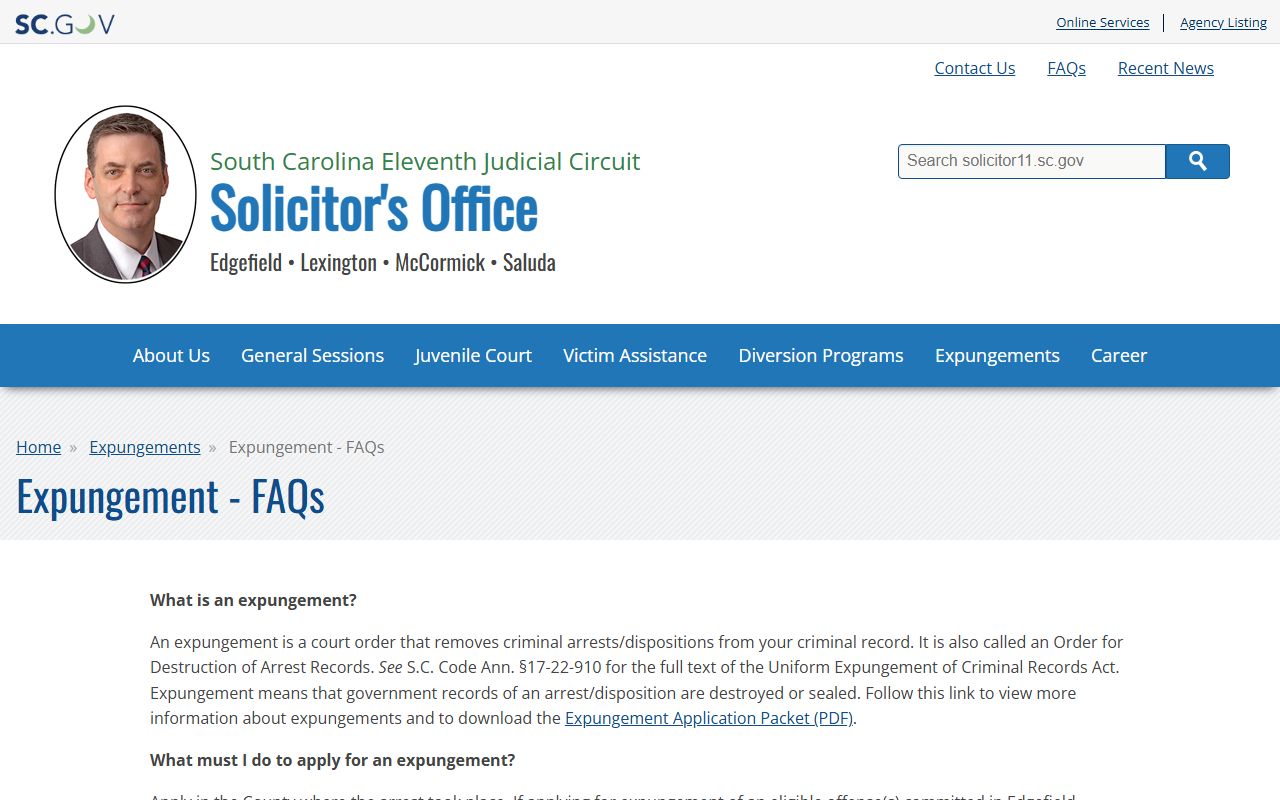
Expungement research should start with the county where the arrest took place, which includes Lexington County for local arrests.
Public Criminal Record Access
Criminal case records are generally searched through Public Index and local court offices, but the access rule depends on the record. Rule 610, SCACR governs many judicial records requests, while South Carolina FOIA applies to many county administrative records. S.C. Code Section 17-1-40 and S.C. Code Section 17-22-910 et seq. are key criminal expungement sources.
Public Index also has technical and privacy caveats. Cookies and JavaScript must be enabled, a pop-up exception may be needed for details, and home address information no longer displays on the public index as of January 1, 2026. Court staff can provide procedural record information, but they cannot give legal advice.
Important: Criminal court records are not FCRA consumer reports and should be verified with the originating court before use.